
The $6.34 billion hack that began with a job interview
North Korean hackers stole $6.34 billion from Binance in 20 minutes. How they got in, and the lessons every IT professional, executive and organisation must learn.
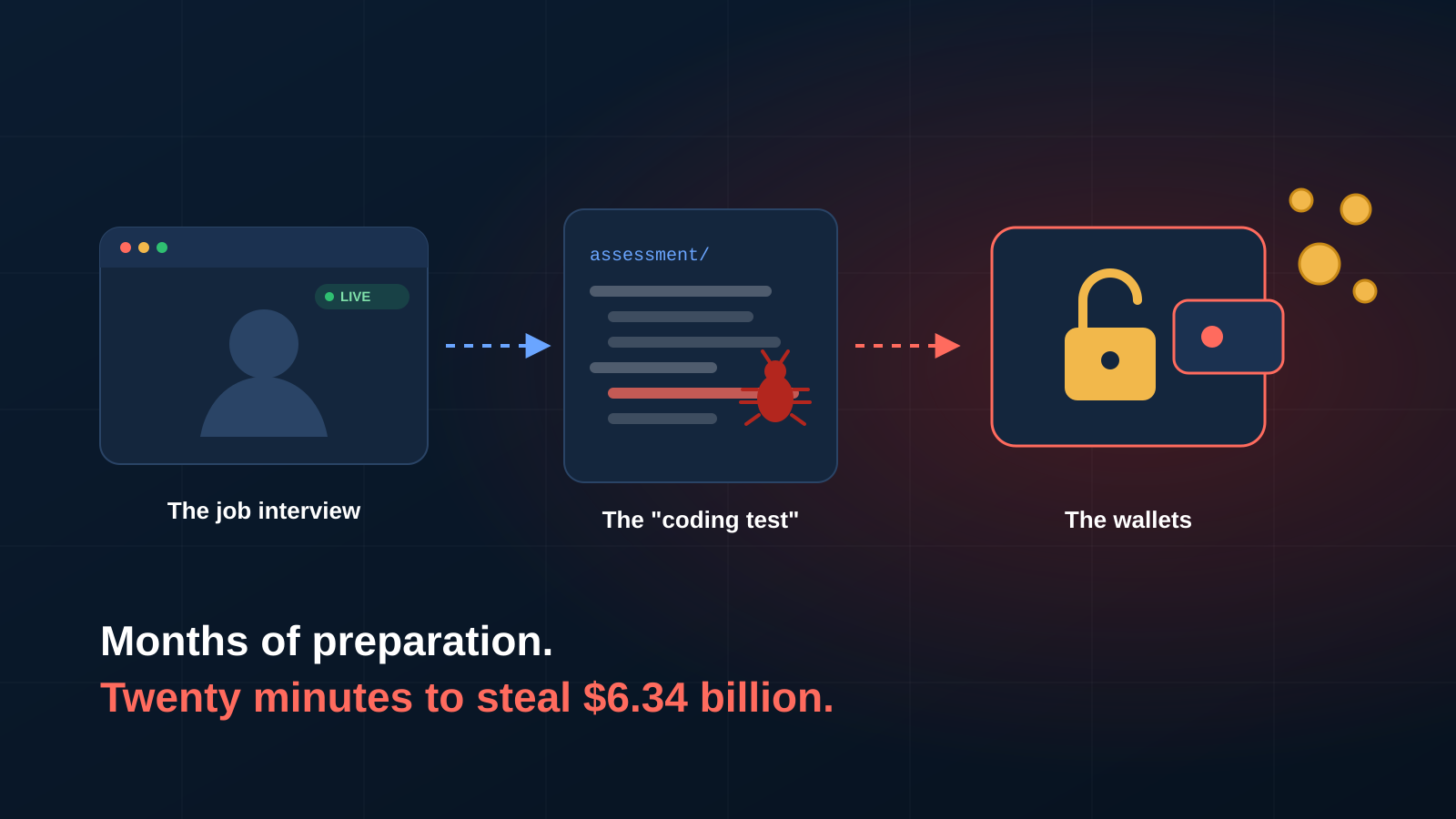
On October 29, 2026, at around 9:05 p.m. (WAT), the largest financial hack in history happened. Binance, the world's largest cryptocurrency exchange, had approximately $6.34 billion (₦8.54 trillion) stolen from its wallets. The money was moved within just 20 minutes.
To put that amount in perspective, it is more than the combined capital base of Nigeria's five largest commercial banks.
The FBI has traced the attack to TraderTraitor, a North Korean state-sponsored hacking group.
As staggering as the amount is, what fascinates me most, and the reason I am writing this, is how the hackers pulled it off and the lessons every IT professional, business executive and organization must learn from it.
Because the hackers did not simply break through Binance's firewall. They spent months studying the company's employees, identifying their interests, exploiting their work routines and systematically gaining access to its most sensitive systems.
And one of their most successful entry points was a job interview.
Here is what happened.
In September 2026, a Binance software engineer was contacted through a legitimate recruitment platform by someone presenting himself as a project director. The engineer's profile showed that he worked at Binance, making him an attractive target.
The project director introduced the engineer to someone claiming to be an HR representative, who conducted a live video interview. The interviewer even shared a social media profile containing personal pictures and videos to establish credibility.
A second interview followed, this time with someone claiming to be the CEO of the recruiting company.
Everything appeared normal. There was a recruitment platform, a project director, an HR representative, a CEO and actual interviews.
Except that the company did not exist.
The entire recruitment process was a carefully constructed deception.
Towards the end of the interview, the engineer was given a technical assessment to complete. Again, this was perfectly consistent with how software developers are recruited. Employers routinely ask candidates to complete coding assignments to demonstrate their competence.
The engineer was instructed to download a code repository containing the assessment.
That was the trap.
Unknown to him, the repository contained malicious code that would execute during the setup process. He downloaded it onto his work computer, and the attackers gained a foothold inside Binance.
The malware was sophisticated. It replaced a legitimate component of a development tool, established communication with a server controlled by the hackers and attempted to conceal its activities.
Even the security software installed on the computer failed to detect it.
But there is another part of this story that makes the operation even more troubling.
The recruitment deception was not the first successful intrusion.
Three months earlier, in June 2026, another Binance engineer working on the company's wallet infrastructure had searched online for a popular AI coding tool. During the installation process, he downloaded a tampered version of Homebrew, a widely used software installation tool.
The hackers had planted malicious software inside the modified installer.
Binance's security team actually detected this earlier compromise, replaced the computer and renewed the affected credentials.
You would think that settled the matter.
It did not.
The attackers had already obtained valuable information about the engineer's responsibilities and the identities of colleagues working on Binance's wallet infrastructure.
They knew more about their targets and were preparing their next move.
By October 20, the hackers had taken advantage of the computer compromised through the fake recruitment exercise and exploited an internal AI tool to gain control of two additional engineers' computers.
They then discovered something particularly valuable. One of the engineers had a security token that permitted software deployment within part of Binance's infrastructure.
That token was effectively a key to a much more sensitive environment.
The hackers had moved from deceiving an employee to controlling computers and credentials belonging to people responsible for critical financial infrastructure.
On October 29, they used the stolen credentials and compromised systems to gain unauthorized access to Binance's wallet transaction-signing service.
For those who may not understand how cryptocurrency works, exchanges maintain what are called hot wallets. These are digital wallets connected to the internet, allowing the exchange to process transactions.
The wallet-signing service is responsible for authorizing transactions from those wallets.
Once the hackers compromised that service, they could initiate transfers outside Binance's normal withdrawal process.
And they did.
Within minutes, enormous amounts of Bitcoin, Ethereum, XRP and other digital assets began moving into wallets controlled by the attackers.
On the Ethereum network, the hackers went further by abusing a transaction authorization feature known as EIP-7702 to grant a malicious smart contract permission to execute operations on behalf of a Binance wallet.
In simple English, they created a way to continue moving money even after Binance began shutting down its normal withdrawal systems.
This explains why suspending withdrawals did not immediately stop the theft. Some of the malicious authorizations had already been recorded on the blockchain and had to be separately revoked.
By the time the operation was contained, approximately $6.34 billion had been affected. Binance subsequently reported that about $2.85 billion had been frozen or intercepted, and committed to absorbing the financial losses rather than passing them to its customers.
Now, what should every organization learn from this?
The first lesson is that your cybersecurity infrastructure is only as strong as the controls around the people and systems that have access to it.
The hackers did not begin by confronting Binance's strongest defenses. They targeted legitimate employees and exploited activities those employees considered perfectly normal.
A job interview. A coding assessment. A software installation. An AI development tool.
Nothing particularly extraordinary about any of them.
Yet, through a combination of these ordinary activities, the attackers compromised one of the world's largest financial technology platforms.
What makes this incident particularly instructive is that Binance was not an organization without a security team. According to the company's report, its security team had detected and prevented 57 suspected North Korea-linked cyberthreats during 2026.
Yet this one succeeded.
In February 2025, North Korean hackers were also linked to the theft of approximately $1.5 billion from Bybit, another cryptocurrency exchange. At the time, it was the largest cryptocurrency theft ever recorded.
Just 20 months later, the record was broken by more than four times.
These are not ordinary internet fraudsters looking for unsuspecting victims to send them money. We are dealing with organized, sophisticated and patient attackers who study their targets, identify weaknesses and spend months preparing to exploit them.
And while many organizations are still treating cybersecurity as an annual training exercise or something the IT department should handle, these criminals are continuously improving their methods.
For me, the most important lesson from this incident is not the $6.34 billion stolen.
It is that an operation of this magnitude could begin with something as ordinary as a software engineer accepting an invitation for a job interview.
The hackers spent months preparing. The actual theft took minutes.
That is the reality every organization must prepare for.
Vincent Dania is an adjunct instructor at University of the People and the CEO of hyrax.ng - The AI Enablement Company.